
What to Include on a Therapist Website: A Page-by-Page Checklist
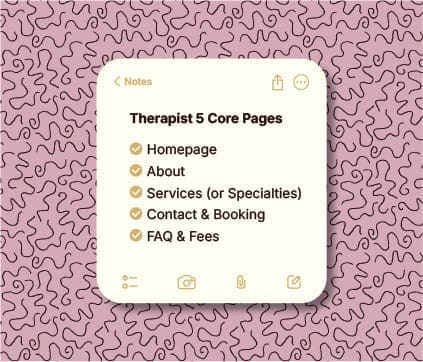
Ever felt that “blank-page overwhelm”? You’re staring at a new site build with no idea where to even start, or a half-finished DIY site with pages added at random — and somewhere in there, you realize you actually have no idea what to include on a therapist website.
I’ve built custom websites for therapists and other service providers for three years, and I know exactly what a well-functioning site needs — and what it doesn’t. This article will give you a clear page-by-page breakdown of what each page needs to do, what to skip, and a free downloadable checklist to take with you.
Quick Answer: The Pages Every Therapist Website Needs
If you’re wondering what pages to include on a therapist website, here’s the short answer: at minimum, a therapist website needs five pages — a homepage, an About page, a services or specialties page, a contact and booking page, and an FAQ or fees page. A few optional pages are worth considering too, which we’ll cover further down, along with a free downloadable checklist to make sure your site has everything it needs.
Homepage
A strong therapist homepage should answer three things within seconds: who you help, how you help them, and what to do next. The job is simple, but often hard to execute.
Your homepage needs a few key things: one clear sentence describing who you serve, real personality (not just generic stock imagery), and one clear call to action. Common mistakes include too much text, no clear differentiation, and either no obvious next step or several competing ones. Visitors shouldn’t have to decipher metaphors or scroll endlessly just to figure out if they’re your ideal client.
About Page
The About page’s job is to build trust and connection — it’s often where a hesitant visitor decides whether to reach out, so it deserves as much care and personality as your homepage. Key elements include your approach or philosophy in plain language (watch out for too much industry jargon), credentials stated simply rather than as a dense list, a real photo, and your actual voice. Writing the About and Home pages well deserves its own deep dive, which I’ll cover in a future post.
Services or Specialties Page
The Services page’s job is to help a visitor self-select whether you’re the right fit for what they’re dealing with. Key elements include specific, named specialties rather than “I treat everyone,” and plain language over clinical jargon. Organizing the page around what clients are actually searching for — like anxiety or couples therapy — makes it easier for the right client to recognize themselves in your work, rather than relying on modality names alone.
Contact and Booking Page
Your contact and booking page’s job is to remove friction — it’s arguably your most important conversion page. It should answer two things before a visitor even reaches out: how do I get in touch, and what happens next? Key elements include your phone and email, an inquiry form or booking link, and what to expect after reaching out (response time, what the first step looks like).
FAQ and Fees Page
A therapist FAQ page should answer the questions a potential client is too nervous to ask over email — things like session fees, insurance and superbills, sliding scale availability, your cancellation policy, and whether you offer telehealth, in-person sessions, or both.
It’s worth including even if some of it repeats information found elsewhere on your site. It’s much easier for a client to scan your FAQ for the one answer they need than to read your entire website looking for it. FAQ pages also tend to matter for SEO, since the question-and-answer format often matches the exact way people phrase their Google searches.
Should you combine your FAQ and fees, or keep them separate?
It depends on the size and complexity of your practice. If you’re a solo practitioner, combining your FAQ and fees into one page usually works well — there’s less to navigate, and most of the information applies to just you. If you run a group practice, or have a more complex fee structure (multiple providers, varying rates, several insurance panels), splitting them into two pages tends to be clearer for visitors trying to find the specific information that applies to them.
Optional Pages
Blog
A blog supports long-term search visibility and showcases your expertise. It isn’t essential for a strong launch, though, and not every practice needs one right away.
Resources or Client Portals
Links to outside resources, downloadable content, or a client portal can be a nice addition if you already have that kind of content ready to share. It isn’t essential, though, and it’s easy to add later once the rest of your site is built.
Testimonials
Testimonials are common on service-based business sites in general, but many therapy licensing boards restrict their use due to confidentiality and solicitation rules. Always confirm your state and licensing board’s current rules before adding client testimonials to your site. A peer review or professional endorsement from a colleague is often a safer alternative. Testimonials can also be added to your homepage, about page, or sprinkled throughout your site rather than on their own page.
What to Leave Off Your Therapist Website
Now that we’ve covered what to include on your therapist website, let’s talk about what you can leave off.
A therapist website doesn’t need more pages to be effective — it needs the right five, written clearly, with one clear next step on each. One consistent call to action throughout your site will do more for you than several different ones scattered across different pages.
You can also ditch generic stock photography. A professional photoshoot is ideal, but if that’s not in the budget right now, thoughtfully chosen stock photography is a reasonable middle ground — just make sure it’s selected intentionally, to match your brand colors, mission, and personality, rather than grabbed at random.
Overly clinical language is another thing to leave off. It can alienate potential clients who aren’t therapists themselves and don’t relate to industry terminology.
All of this works against conversion, not for it. The pages that convert best aren’t the ones with the most content — they’re the ones built with intention, where every page, photo, and word is there on purpose.

Get the Free Checklist of What to Include on a Therapist Website
Download a PDF checklist here, no email sign-up necessary!
Frequently Asked Questions
At minimum: a homepage, an About page, a services or specialties page, a contact and booking page, and an FAQ or fees page. Everything else is optional and can be added as your practice grows.
Not right away. A blog helps with long-term visibility in search and shows your expertise, but it isn’t essential for a strong launch. Start with your core pages, then consider a blog once that foundation is solid.
That’s a personal choice. Some therapists list exact rates; others list a range or simply note “contact for current rates.” Either way, addressing cost somewhere on your FAQ or fees page tends to reduce inquiries that aren’t a good fit.
It depends on your state and licensing board — many have specific restrictions around testimonials due to confidentiality and solicitation rules. Always check your board’s current guidelines before adding them.
Your approach or philosophy in plain language, your credentials stated simply, a real photo, and some sense of your personality.
Most solo practices do well with 5-7 pages. More isn’t necessarily better — a tightly focused site with a clear next step on each page usually serves visitors better than a sprawling one.
Not always. Many solo practitioners combine them into one page. Group practices or those with more complex fee structures (insurance, sliding scale, multiple providers) often benefit from separating them. FAQs are helpful to have for SEO purposes.
That’s normal and okay. Your services page doesn’t need to be unique in what you treat — it needs to be specific and written in your own voice, so the right client still recognizes themselves in it.
Ready to Build a Site with Everything it Needs?
These pages shouldn’t be built in isolation: brand strategy is what ties them together, and it’s what I focus on with every client project. An effective website starts with a solid brand strategy and brand identity — something I’ll cover in more depth in a future post.
A few well-built, focused pages beat a sprawling site every time: this is about clarity, not quantity. Use the checklist above to audit your current site, or to plan a new one from scratch, and check out How Much Does a Therapist Website Cost?
If you’re ready for a custom website design for therapists, head over to my inquiry form and send me a message — I’d love to chat about building you a new website.


Be the first to comment